Where Memory Becomes Matter
An Exclusive Conversation on Painting, Fragments, Research, and Time
Exclusive Interview conducted and published by Sundram Kumar (Founder & Editor, Astra Global Ventures) with Portuguese painter José Brito.
Artist Biography
José Brito (born in 1958 in Lobão da Beira, Tondela, Portugal) is a Portuguese painter who lives and works in Lisbon. His artistic practice explores the unstable relationship between image, memory, materiality, and time. Through layers of collage, fragments of images, erasures, gestures, and processes of concealment and emergence, his paintings construct surfaces in which the image is never entirely fixed.
He studied Arts and Techniques of Fire at the António Arroio School of Decorative Arts in Lisbon. He holds a degree in Fine Arts – Painting from the Faculty of Fine Arts of the University of Lisbon and a Master’s degree in Art History from Universidade Lusíada, Lisbon.
Over more than three decades, his work has been presented in individual and collective exhibitions in Portugal, Brazil, Spain, Italy, Germany, Austria, Venezuela, and Ukraine, among other international contexts. His paintings are held in institutional and private collections in Europe, Asia, Latin America, and North America.
Official Blog: https://josebritosantos.blogspot.com/
1. Your artistic journey spans more than three decades. Looking back, what have been the defining moments that shaped your identity as an artist?
José Brito: I do not think that my identity as an artist was shaped by a single defining moment. It was formed gradually, through a succession of experiences, encounters, doubts, and discoveries that have continued throughout my life. I was born in 1958 in Lobão da Beira, a small village in central Portugal. When I look back, I often think of the landscape of my childhood—the mountains, the valleys, the silence, and the feeling of being part of a place that was at once very small and connected to something immeasurably larger. I think that experience has remained with me. From a very early age, I felt that a concrete place could become the starting point for a much wider movement of the gaze and of thought. One could begin in a small place and, from there, imagine a world that extended far beyond what was immediately visible. In some way, I believe my entire artistic journey has continued from that experience. My education, my move to Lisbon, my studies in the arts and art history, my encounters with artists, writers, exhibitions, and different cultural contexts all contributed to the development of my practice. But I do not see these experiences as a linear path towards a predetermined artistic identity. Rather, they gradually taught me to remain attentive to questions. Over the decades, painting became increasingly important to me as a way of thinking not only about images, but about memory, time, matter, human experience, and the uncertainties of existence. Perhaps the defining moment was not the moment when I found an artistic identity, but the gradual understanding that I did not need to find a final one. I needed to continue searching. That need to continue searching has probably been the most constant element of my life as an artist.
2. Every painting begins somewhere. What is usually the first spark that leads you to create a new work?
José Brito: For me, a painting rarely begins with a fully formed idea or a clearly defined subject. More often, it begins with a disturbance—something I cannot yet clearly name. Sometimes the initial impulse may come from an image, a memory, a sensation, a fragment of experience, or even from a material relationship that suddenly attracts my attention. But these elements are rarely the starting point of a predetermined plan. What usually leads me to begin is a feeling that something remains unresolved. I may have an image in my mind, or an intuition that I cannot yet translate into words. I may feel the need to place something on the surface without knowing exactly what the painting will become. The first gesture is therefore not necessarily an act of expression, but an act of opening. I begin in order to discover what the painting may reveal. This is one of the reasons why the material process is so important to me. I work through layers, fragments, traces, interruptions, and transformations. The painting gradually becomes a space in which intention and discovery meet. I do not always know where the work is going when I begin. In fact, I think that if I knew the final result too clearly, the process would lose much of its necessity. For me, the first spark is often not an answer, but a question or even the feeling that a question exists before I am able to formulate it. The painting begins there.
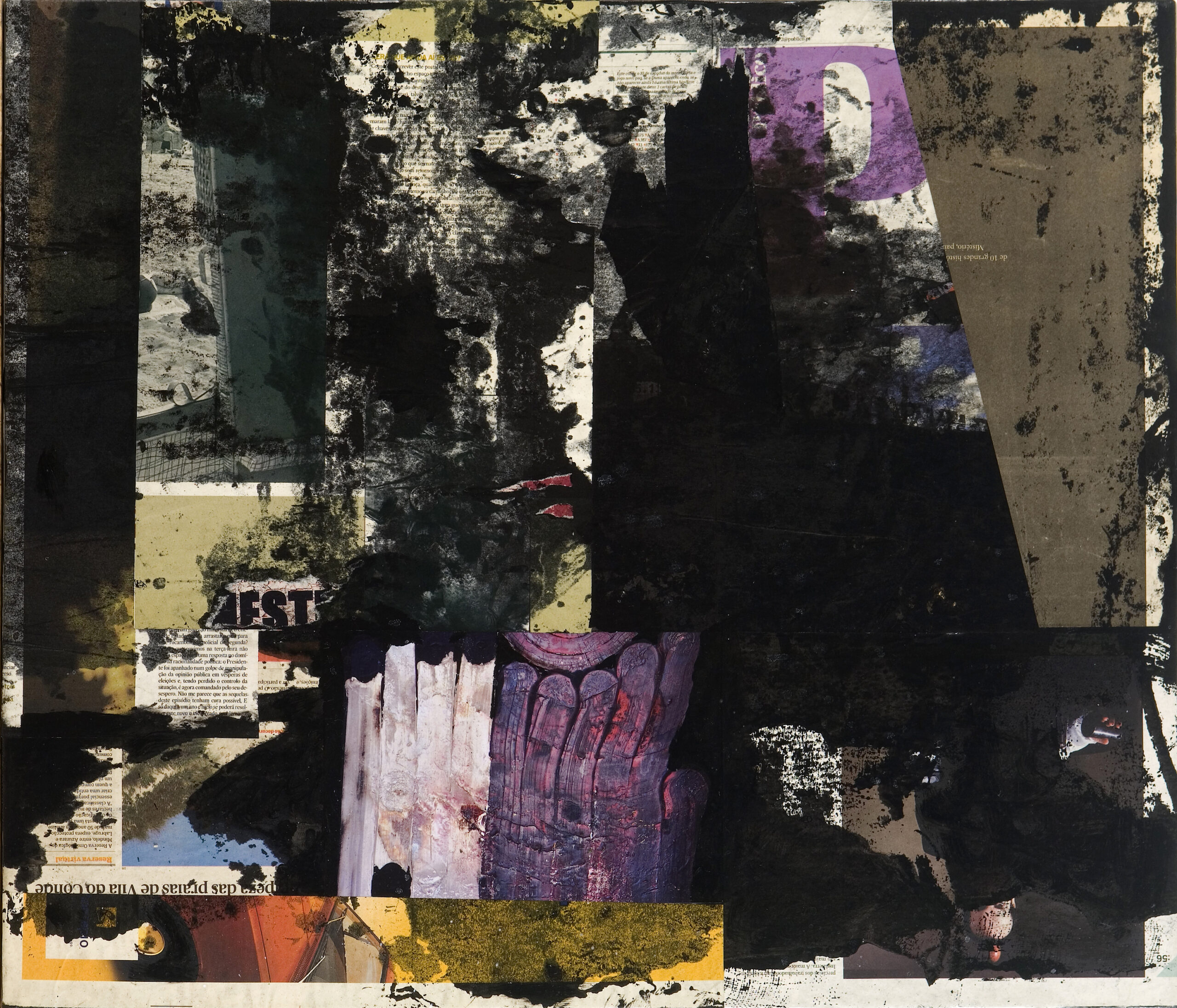
José Brito — Tudo o que não se fixa, 2010. Técnica mista sobre tela, 60 × 70 cm.
3. Was there a particular moment when you felt you had truly found your own artistic voice? What changed?
José Brito: I do not think there was a single moment when I suddenly felt that I had found my own artistic voice. For me, it happened gradually. In fact, I have always been somewhat suspicious of the idea of “finding” a definitive artistic language. A voice is not something that, once discovered, remains unchanged. It develops through time, through work, doubt, failure, transformation, and the willingness to continue questioning what one has already achieved. There was, however, a gradual change in my understanding of what painting could be. I began to move away from the idea that a painting should necessarily begin with a clearly defined image or arrive at a predetermined result. I became increasingly interested in fragmentation, layers, materiality, erasure, traces, and the unstable relationship between what appears and what disappears. At a certain point, I understood that these were not simply formal choices. They were connected to the way I experienced the world and to the way I wanted to think through painting. What changed was perhaps my relationship with uncertainty. I became less concerned with trying to make the painting conform to an idea I already possessed, and more willing to allow the work itself to participate in the process of discovery. The painting became less an illustration of something I already knew and more a place where thought could take form. Looking back, I believe that my artistic voice did not emerge when I found a formula that could be repeated. It emerged when I began to understand that the need to search and the uncertainty that accompanies that search was itself an essential part of my language. Perhaps I found my voice when I understood that I did not need to sound like anyone else, but also that I did not need to constantly prove that I was different. I simply needed to remain faithful to the necessity of the work.
4. Over the years, what has changed the most in your artistic practice, and what has remained constant?
José Brito: Over the years, many aspects of my artistic practice have changed. My relationship with materials has evolved, as has my understanding of the image, the surface, the gesture, and the process of painting itself. In the earlier stages of my career, I was perhaps more concerned with constructing an image. Over time, I became increasingly interested in what happens when an image is interrupted, fragmented, partially erased, or transformed through the material process of painting. The surface became more important to me not as a neutral support, but as an active field in which different layers, fragments, traces, and gestures can coexist and enter into tension with one another. My relationship with certainty has also changed. I have become more willing to accept that a painting can remain open, unstable, and unresolved. I no longer feel that every question raised by a work necessarily needs to be answered within the work itself. What has remained constant is more difficult to define, but perhaps more essential. The need to continue searching has remained. I have always felt that painting should take me somewhere I do not yet fully know. Even when my methods and visual language have changed, I have continued to enter the studio with the feeling that something remains to be discovered. The materials have changed. The processes have changed. My understanding of painting has changed. But the fundamental need to paint and to think through painting has remained. Perhaps the greatest continuity in my work is not a particular style or visual formula, but a certain attitude towards uncertainty. I continue to believe that painting should preserve the possibility of discovery.
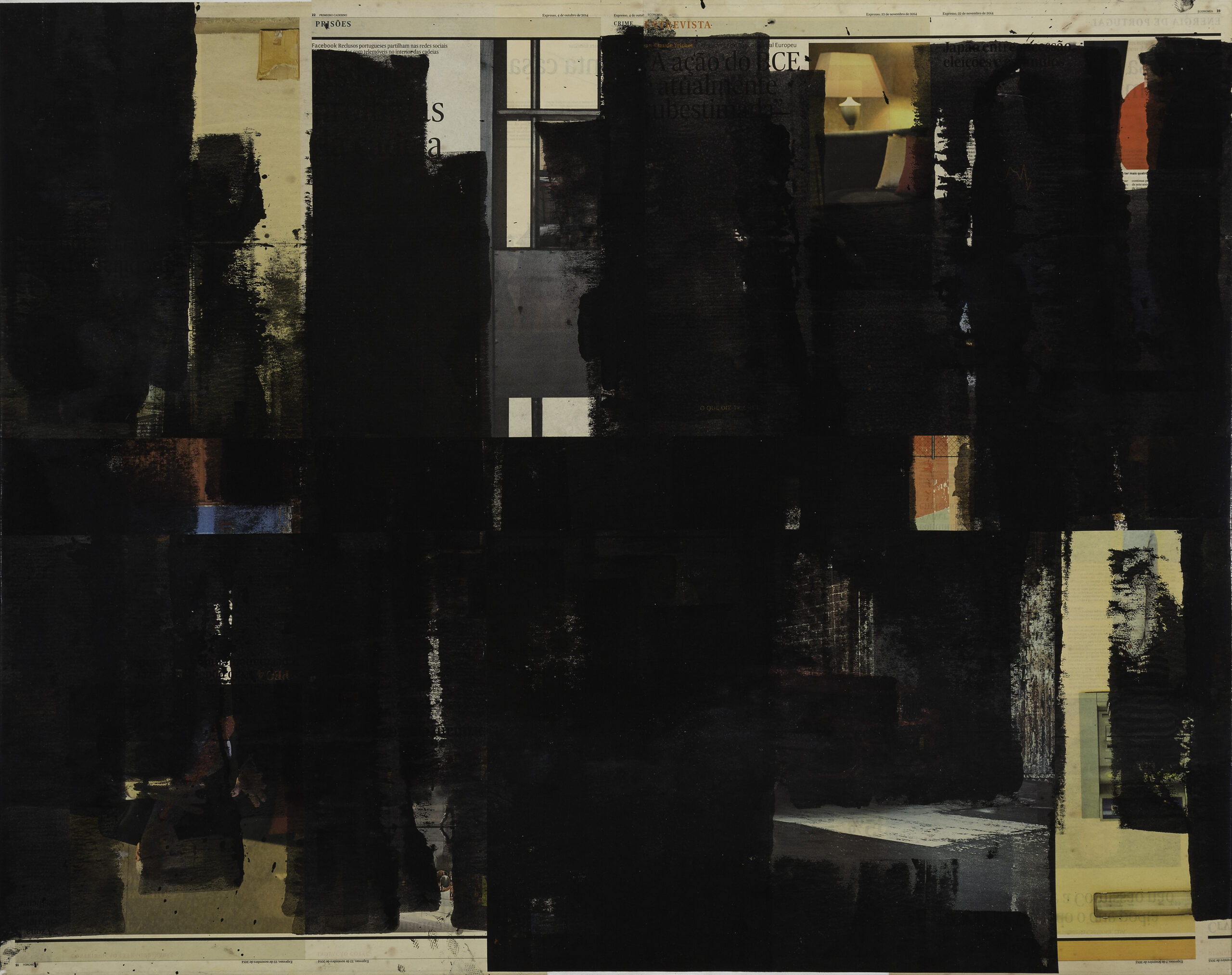
José Brito — Nada se dá por inteiro, 2015. Técnica mista sobre tela, 125 × 100 cm.
5. After so many years of painting, what continues to challenge and inspire you every time you enter the studio?
José Brito: After so many years of painting, what continues to challenge me is the possibility of beginning again. Experience brings knowledge, but it also brings the danger of repetition. I know more today about materials, processes, and painting than I did when I began, but I am also more aware of how easily knowledge can become a limitation if it turns into a formula. Every time I enter the studio, I am still confronted by the same fundamental uncertainty: how can I begin something without simply repeating what I already know? That remains a challenge. I do not want to reproduce a style that I have already established. At the same time, I do not believe that an artist should constantly try to be different merely for the sake of being different. The challenge is to remain faithful to the necessity of the work while remaining open to the possibility of change. What continues to inspire me is the fact that painting can still surprise me. A material may behave unexpectedly. A gesture may produce something I had not anticipated. A layer may partially disappear and reveal another possibility beneath it. A painting may begin to move in a direction that I had not planned. These moments of discovery remain essential to me. I am also inspired by the simple fact that there is always something I do not yet understand. After decades of painting, I do not feel that I have exhausted the possibilities of the medium. On the contrary, the more I work, the more conscious I become of what remains unknown. Perhaps this is what continues to bring me into the studio: the possibility that the next painting may reveal something that I could not have discovered in any other way. Painting continues to challenge me because it does not allow me to remain completely comfortable with what I already know. And it continues to inspire me because, even after all these years, I still believe that something remains to be discovered.
6. Your paintings are known for their rich textures, layers, and abstract language. What draws you to this visual approach?
José Brito: I am drawn to layers, texture, fragments, and abstraction because they allow the painting to remain open to transformation. For me, the surface of a painting is not a neutral support on which an image is simply placed. It is a space in which things can appear, disappear, overlap, be interrupted, and return in another form. I often think of the painting as a kind of living surface. Each layer carries the memory of what came before it, even when that earlier layer is partially covered or erased. What disappears is not necessarily lost. It may continue to exist as a trace, a pressure, a memory within the material. This is one of the reasons why I am interested in collage, fragments, and the accumulation of different materials. They allow the painting to contain different moments of time. I do not see abstraction as a rejection of reality. For me, it can be another way of approaching reality—particularly those aspects of experience that cannot be completely translated into a fixed image or a clearly defined narrative. The rich materiality of the surface is therefore not simply a visual effect. It is connected to the way I think about memory and experience. We do not experience life as a perfectly coherent image. Our memories are fragmentary, layered, incomplete, and constantly transformed by time. In a similar way, I want the painting to preserve a certain instability. The image may emerge, but it should not necessarily become completely fixed. I am interested in the moment when something becomes visible and, at the same time, remains partially beyond our grasp. Perhaps this is what draws me most strongly to this visual language: it allows painting to become not merely an image, but a place where presence and disappearance, construction and erasure, certainty and doubt can exist together.
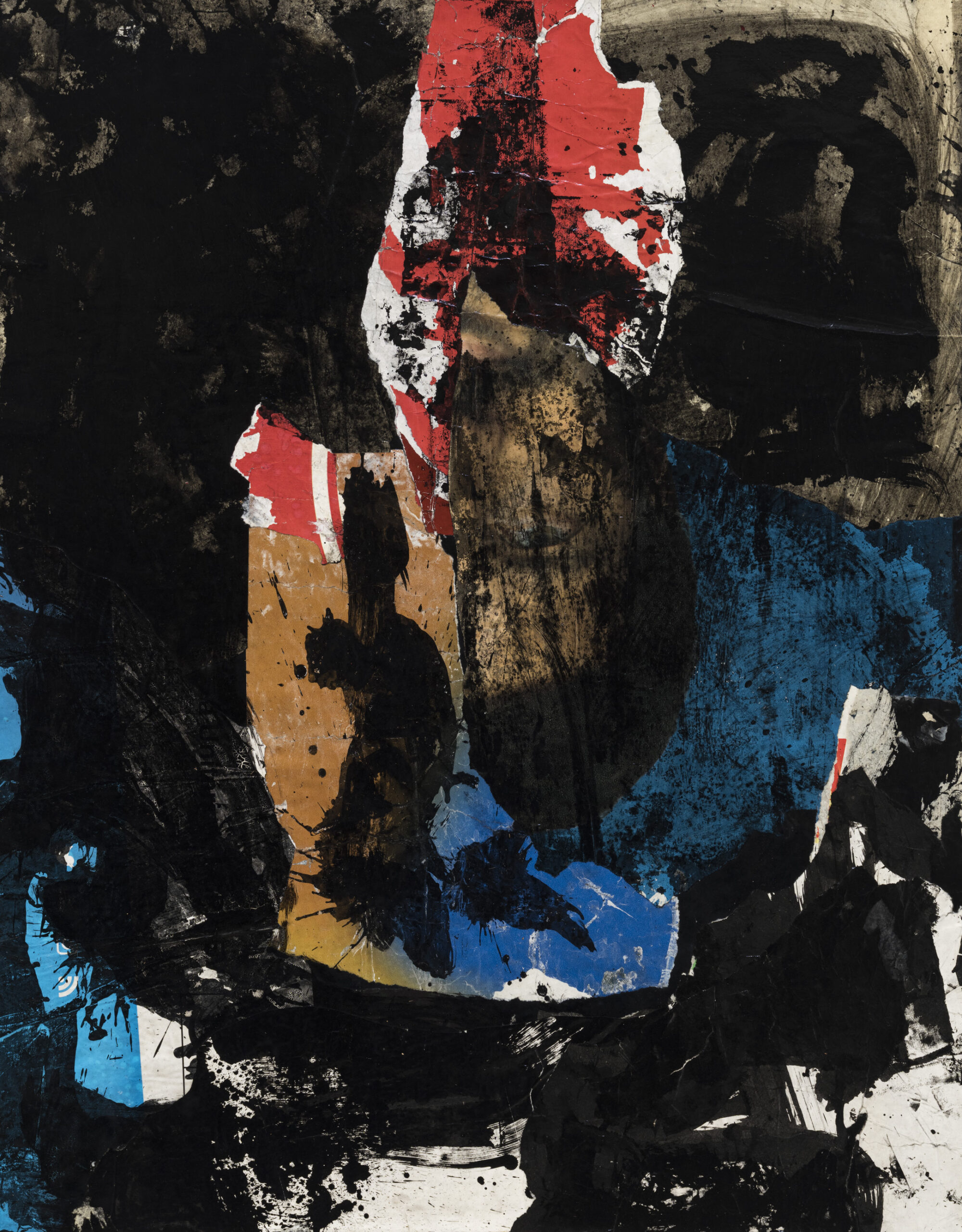
José Brito — A imagem como passagem, 2023. Técnica mista sobre tela, 152 × 120 cm.
7. You describe research as an essential part of your artistic practice. How does research become part of the creative process?
José Brito: Research is an essential part of my artistic practice, but I do not see research as something separate from painting. For me, the studio itself is a place of research. I investigate through reading, looking, studying the history of art, reflecting on images, and thinking about the relationship between painting, memory, materiality, and time. But I also investigate through the physical act of making the work. The materials themselves generate questions. A fragment of paper, a layer of paint, a gesture, an erasure, or an unexpected transformation can lead the work in a direction that I had not anticipated. In this sense, research does not always precede the painting. It often develops together with it. My academic research, particularly my work in art history and my doctoral research on collage, the fragment, and the ontology of painting, has given me tools with which to think more deeply about my practice. But I do not use theory to explain or justify the paintings after they have been made. Rather, theory and practice remain in dialogue. Sometimes a theoretical question can enter the studio and influence the way I look at the surface. At other times, a material discovery in the studio raises a question that leads me back to reading, research, or reflection. The relationship is therefore circular. Painting produces questions. Research deepens them. The questions return to the studio, where they may take another form through matter, gesture, and image. For me, research is not an attempt to eliminate uncertainty. On the contrary, its purpose is often to make me more aware of what I do not yet understand. This is perhaps why research is so important to my practice: it does not provide definitive answers to painting. It allows painting to continue asking more complex questions.
8. Many viewers discover different meanings within abstract art. Do you prefer your work to remain open to interpretation, or does each painting begin with a specific intention?
José Brito: I think each painting begins with some form of intention, although that intention is not always precise or fully conscious. Sometimes I may begin with a particular image, a sensation, a question, or a desire to explore a certain relationship between materials, gestures, and surfaces. But I do not want the painting to remain limited to the intention with which it began. The process of painting inevitably introduces unexpected elements. Materials behave in ways I cannot completely control. A gesture may change the direction of the work. A layer may conceal something that was previously visible, while revealing another possibility. As the painting develops, my initial intention may therefore change. For this reason, I prefer my paintings to remain open to interpretation. This does not mean that they have no intention or that anything can mean anything. It means that I do not believe the artist should completely determine the experience of the viewer. A painting may begin with something that belongs to me, but once it enters another person’s experience, it can establish a different relationship with that person. The viewer brings their own memories, experiences, emotions, and questions. I do not see this as a loss of the artist’s intention. On the contrary, I believe it is part of the life of the work. I often think that the artist creates the work, but the viewer completes the encounter. The painting begins with the artist, but it does not end there. Perhaps this is one of the reasons I am drawn to abstraction. It allows the work to remain open without requiring a single definitive explanation. I do not want to tell the viewer what to see. I would rather create a space in which something may happen between the painting and the person who encounters it. Ultimately, I hope the painting can remain sufficiently open to receive another person’s experience, while still retaining the traces of the intention, decisions, and process through which it came into being.
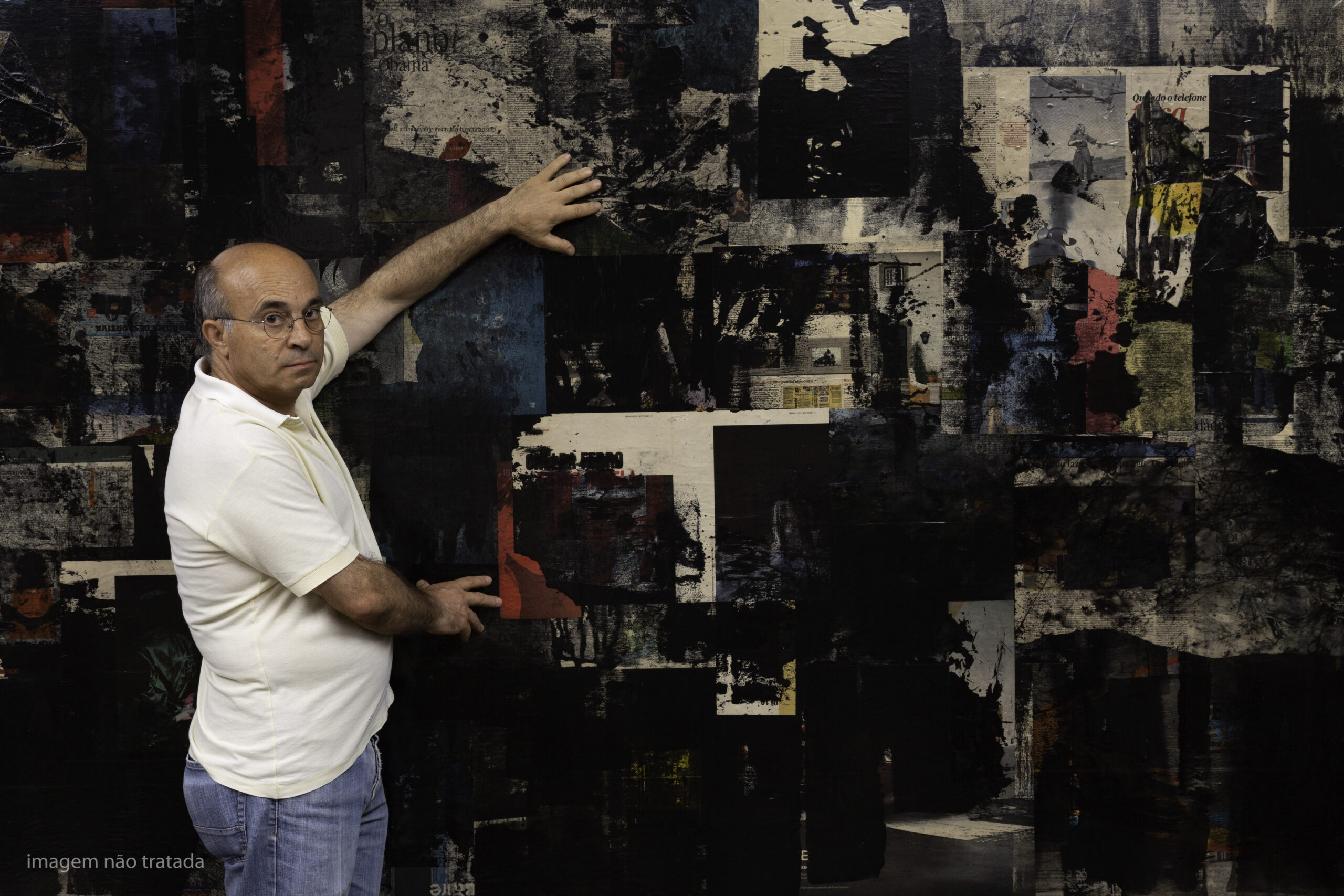
José Brito (Portrait)
9. What role do experimentation, unexpected discoveries, and intuition play while creating a painting?
José Brito: Experimentation, unexpected discoveries, and intuition play a very important role in my painting process. I do not usually enter the studio with every decision already made. I need to leave space for the work to develop through the process itself. Experimentation allows me to discover possibilities that I could not have reached through planning alone. I may change a surface, introduce a new material, cover something that was previously visible, or make a gesture without knowing exactly what its consequence will be. Sometimes these decisions lead nowhere. Other times, they open a possibility that I had not anticipated. The unexpected is therefore not something I try to eliminate from the process. I try to remain attentive to it. Intuition is also important, although I do not see it as something entirely separate from knowledge or experience. After many years of working, one develops a certain sensitivity to the material, to the surface, and to the moment when something is beginning to happen in a painting. This sensitivity can sometimes be difficult to explain rationally. I may feel that something is working, or that something needs to change, before I can fully explain why. At the same time, intuition should not become an excuse for avoiding reflection. I believe that painting involves a continuous movement between intuition and awareness, between allowing things to happen and making decisions. The work often moves between these two states. There are moments when I deliberately act, and others when I respond to something that has emerged unexpectedly. A painting is built through this dialogue. I think that experimentation is important because it keeps the process alive. It prevents me from simply repeating solutions that I already know. The unexpected can open a new direction. And intuition allows me to recognise, sometimes before I can explain it, when that direction may be worth following. For me, the creative process is therefore neither completely controlled nor completely accidental. It is a conversation between intention, material, experience, chance, and attention. The challenge is to remain sufficiently open to what I did not expect, without losing the responsibility of making decisions.
10. How do you decide that a painting is complete, especially when abstraction offers endless possibilities?
José Brito: I do not think a painting is complete because there is nothing more that could possibly be done to it. In abstraction, there are always further possibilities. A surface can always be altered, another layer can be added, something can be erased or transformed. At a certain point, however, I begin to feel that the painting has reached a certain internal balance—not necessarily a balance of harmony or stability, but a point at which the different elements of the work begin to exist in a necessary relationship with one another. This is difficult to define completely in rational terms. Sometimes I know that a painting is finished because I feel that another intervention would no longer be necessary. It might still be possible, but it would no longer be necessary. That distinction is important to me. A painting can always be changed. The question is whether it still needs to be changed. I also think that finishing a painting involves accepting a certain degree of uncertainty. If I waited until every possibility had been exhausted, I would never be able to finish a work. At some point, I have to accept that the painting has reached a moment in which it can exist on its own. This does not mean that I feel complete certainty about it. In fact, I often think that a painting can be finished while still containing unresolved questions. Perhaps this is one of the paradoxes of painting: a work can be complete without being closed. I usually stop when I feel that the painting has become sufficiently itself—when further intervention might begin to take away from its internal necessity rather than add to it. And even then, I sometimes have to step away from the work for a while before I can understand whether it is truly finished. In the end, completing a painting is also an act of trust. I have to trust that the work has reached the point where it can continue its existence without me.
11. Your work has been exhibited in several countries. How have different cultures and audiences influenced your artistic vision?
José Brito: Exhibiting my work in different countries has been an important part of my artistic journey, but I would not say that different cultures have simply changed my artistic vision in a direct or predictable way. What they have done is broadened my awareness. Every context brings different histories, sensibilities, traditions, and ways of looking at art. Encountering different audiences has reminded me that a painting can generate very different responses depending on the experiences and cultural backgrounds of the people who encounter it. I find this difference very enriching. A painting may begin in a very personal place, connected to my own memories, experiences, and questions, but once it enters another context, it can begin to establish relationships that I could not have anticipated. I have always been interested in this movement between the personal and the universal. I was born in a small village in central Portugal, and in some ways my relationship with landscape, silence, memory, and place remains deeply connected to that origin. At the same time, my work has travelled through different countries and encountered people with very different cultural experiences. I do not see these two dimensions as contradictory. Perhaps one of the things I have learned is that a work does not need to abandon its particular origin in order to communicate beyond it. On the contrary, sometimes it is precisely through the specificity of a personal experience that a broader connection becomes possible. The different places where my work has been exhibited have therefore not given me a new artistic identity. Rather, they have helped me understand that the life of a painting continues to expand beyond the circumstances in which it was created. Each audience brings its own experience to the encounter. For me, this is one of the most fascinating aspects of art: the work remains itself, but the encounter with it is never exactly the same. The different cultural contexts I have encountered have made me more attentive to this openness. They have reminded me that painting can begin in a very particular place and still travel towards experiences that are much wider than its origin.
12. In today’s rapidly changing world, what do you believe is the role of contemporary art?
José Brito: I believe that contemporary art has an important role in today’s rapidly changing world, although I do not think that its role can be reduced to a single function or message. We live in a time of enormous speed, constant information, technological transformation, and immediate communication. In such a context, I believe art can create a different kind of space—a space for attention, reflection, uncertainty, and encounter. I do not think that art necessarily needs to provide answers to the problems of the world. Sometimes its role may be to ask questions that cannot be easily resolved. Art can also remind us that not everything has to be immediately understood, consumed, or transformed into information. For me, this is particularly important in relation to painting. Painting requires time. It asks us to remain in front of something, to look again, and perhaps to accept that what we see may not reveal itself immediately. In a rapidly changing world, contemporary art can therefore offer forms of resistance to speed—not necessarily through direct opposition, but by creating experiences that allow us to slow down and become more attentive. I also believe that art can preserve complexity. At a time when many things are reduced to immediate opinions, simplified images, or rapid conclusions, art can maintain ambiguity, contradiction, and the possibility of different interpretations. This does not mean that contemporary art should withdraw from the world. On the contrary, I believe that art remains deeply connected to the world in which it is created. But perhaps its contribution is not always to reflect reality directly. Sometimes it can reveal what is difficult to see, create new ways of perceiving, or simply allow us to remain with a question for longer than we normally would. For me, the role of contemporary art may therefore be less about providing certainty and more about keeping open the possibility of thought, perception, and human encounter. In a world that is constantly changing, perhaps art can remind us that there are still things that deserve to be looked at slowly.
13. How do you view the growing influence of artificial intelligence and digital technologies on the future of visual art?
José Brito: I view the growing influence of artificial intelligence and digital technologies on visual art with both curiosity and caution. I do not think that these technologies should simply be rejected. Every period of artistic history has been transformed by new tools and new technologies. Photography, for example, profoundly changed the history of painting, but it did not make painting disappear. Instead, it forced painting to reconsider its own possibilities. I believe artificial intelligence will also transform the way images are created, perceived, and circulated. It will undoubtedly open new possibilities for artists and may lead to forms of visual expression that we cannot yet fully anticipate. At the same time, I think we should remain attentive to an important distinction. The ability to produce an image is not necessarily the same as the necessity to create one. Technology can generate images with extraordinary speed and complexity. But art is not only a question of producing images. It also involves experience, time, doubt, decisions, failure, memory, and the particular relationship that a human being establishes with the world. For me, this is particularly important in relation to painting. A painting is not only the image that appears on its surface. It also contains the time of its making, the physical presence of the materials, the decisions that were made, the things that were covered or erased, and the traces of a human encounter with matter. I do not know what the future relationship between artificial intelligence and visual art will be. I think it would be premature to make definitive predictions. Perhaps the most important question is not whether technology can produce images, but how artists will use these technologies and how they will redefine what we understand by authorship, originality, experience, and artistic presence. I believe that new technologies will create new possibilities, but they will also make us reconsider what remains essential in art. For me, one of those essential elements is the presence of a human being confronting something that does not yet exist and trying, through a process of uncertainty and discovery, to bring it into existence. Perhaps technology will change the tools through which art is made. But the deeper questions—why we create, what we are trying to understand, and what it means to encounter another human being through a work of art—may remain with us.
14. Which artists, books, historical movements, or life experiences have had the greatest influence on your creative journey?
José Brito: Many artists, writers, thinkers, historical movements, and personal experiences have influenced my creative journey. I would find it difficult to identify a single influence as the most important, because my understanding of art has been formed through the meeting of many different experiences. Among the artists who have been important to me are Rembrandt and Mark Rothko, Antoni Tàpies, Manolo Millares, Robert Motherwell, although in very different ways. I have also been deeply interested in the history of modern art, particularly in the transformations brought about by Cubism and the fragmentation of the image. My relationship with literature has also been extremely important. Writers such as Fernando Pessoa, Rainer Maria Rilke, Dostoevsky, Federico García Lorca, Tennessee Williams, and Marguerite Duras have accompanied my thinking in different ways. Perhaps what I have sought in literature is close to what I seek in painting: the possibility of approaching experiences that cannot be completely reduced to explanation. My academic studies in art history and my research have also played an important role in my development. Thinkers and writers such as Walter Benjamin, Georges Didi-Huberman, Jacques Derrida, Theodor Adorno, Rosalind Krauss, and others have helped me to question the relationship between image, memory, fragmentation, materiality, and time. However, I would not say that these influences simply provided me with answers or models to follow. They often gave me more questions. My personal experiences have been equally important. I was born in a small village in central Portugal, and my early relationship with landscape, silence, memory, and place remains deeply present in my way of seeing. The experience of moving from that small place to Lisbon, studying, encountering different artistic and cultural environments, and later exhibiting in different countries also became part of my formation. I think that an artist is influenced not only by the things they consciously choose to study, but also by everything they have lived through. Sometimes a landscape, a conversation, a book, a period of solitude, or an experience of uncertainty can remain within us for years before we understand that it has become part of our work. Looking back, I believe that my influences have not formed a straight line. They have accumulated, crossed one another, and sometimes reappeared unexpectedly. Perhaps what has influenced me most deeply is the experience of living with questions that do not have immediate answers. The artists, books, movements, and experiences that have accompanied me have not closed those questions. They have helped me continue asking them.
15. What advice would you offer to young artists who wish to build a meaningful and lasting creative career?
José Brito: I would be cautious about offering young artists a formula for building a meaningful and lasting career, because I do not believe that such a formula exists. I can only speak from my own experience. Perhaps the first thing I would say is to remain faithful to the necessity of the work. A career can be important, and exhibitions, opportunities, recognition, and professional relationships are all part of an artist’s life. But they should not replace the work itself. There will be periods of recognition and periods of silence. There will be opportunities that appear unexpectedly and others that never arrive. I think it is important not to allow external circumstances to completely determine one’s sense of value as an artist. I would also encourage young artists to remain curious and to continue learning. Study, look at art, read, question, experiment, and allow yourself to be influenced—but do not become trapped by the need to imitate what is already successful. Try to understand what you genuinely need to investigate. A meaningful artistic career is not necessarily the same as a famous one. For me, a lasting career is one in which the artist continues to develop a sincere relationship with the work over time. This requires patience. It also requires the courage to accept that artistic development is not always linear. There may be moments of doubt, uncertainty, failure, and apparent interruption. These moments can also become part of the journey. I would advise young artists not to be in too much of a hurry to define themselves. A voice takes time. And perhaps it is equally important not to confuse visibility with significance. The contemporary art world can create pressure to constantly be seen, present, and recognised. But the deepest part of an artistic practice often develops away from that visibility. Finally, I would say: protect the questions that led you to begin. The world may eventually ask you to repeat what has already worked. It may encourage you to become a version of yourself that is easier to understand. Try to remain open to change without losing contact with the reason you needed to begin in the first place. A meaningful artistic life may not be the life that follows the most direct path. It may simply be the life in which, after many years, you can still enter the studio and feel that something remains to be discovered.
16. Is there one artwork in your career that represents you better than any other? What makes it especially meaningful to you?
José Brito: It is difficult for me to choose a single work that represents my entire artistic journey, because my work has changed considerably over the years. However, if I had to choose one painting that perhaps brings together some of the questions that have remained important to me, I might choose Tudo o que não se fixa (Everything That Does Not Become Fixed), from 2010. I do not choose it because I consider it necessarily the most important painting I have made, but because its title expresses something that has remained central to my understanding of painting. I have always been interested in the tension between the desire for an image to appear and the impossibility of fixing it completely. In this work, as in much of my painting, the image is not entirely stable. It emerges through layers, fragments, gestures, and material transformations, but it also remains partially uncertain. For me, this is important because I do not believe that a painting needs to offer a completely fixed or definitive image in order to exist fully. The work contains traces of what has appeared and what has been covered, what has been constructed and what has disappeared. In this sense, the painting also carries the memory of its own transformation. Looking back, I can see that many of the questions present in this work continued to accompany me afterwards: the relationship between visibility and disappearance, the instability of the image, the role of materiality, and the possibility of a painting remaining open rather than completely resolved. Perhaps this is why the work is meaningful to me. It does not represent my entire journey, and I would not want any single painting to do so. But it seems to contain a question that has continued to accompany me: How can a painting become present without becoming completely fixed? Perhaps I am still trying to understand that question.
17. What projects, ideas, or creative directions are you most excited to explore in the coming years?
José Brito: I am excited about continuing to explore the questions that have accompanied my painting for many years, while remaining open to the possibility that the work may lead me in directions I cannot yet anticipate. At the moment, I am particularly interested in continuing my investigation into the relationship between image, material, memory, and time. I want to explore further what happens when an image is constructed and then interrupted, when it becomes partially visible and partially concealed, and when the surface of the painting preserves traces of its own transformation. I am also interested in continuing to develop the relationship between collage and painting. Collage has been important to my practice for many years, not simply as a technique, but as a way of thinking about fragmentation, interruption, and the coexistence of different times and materials within the same surface. At the same time, I do not want to define the future of my work too precisely. One of the things I have learned through painting is that some of the most important directions are not always visible at the beginning. A new material, an unexpected discovery in the studio, or a question that emerges from the work itself may open a path that I could not have planned in advance. I am therefore interested in continuing to work, to research, and to remain attentive to what the painting may ask of me. My academic research will also continue to be important to me, particularly in relation to the questions that connect painting, collage, the fragment, materiality, and the instability of the image. But I do not see research and artistic practice as two separate paths. I hope they will continue to question and transform one another. Perhaps what excites me most about the coming years is precisely the fact that I do not yet know everything that will happen. I would like to continue developing the questions I already carry, while remaining open to the possibility that the work may lead me somewhere unexpected. After so many years of painting, I still don’t want to know in advance exactly what the next work will become. I hope that possibility remains.
18. If someone experiencing your work for the first time could see only one painting, which would you choose, and why?
José Brito: If someone were encountering my work for the first time and could see only one painting, I might choose Nada se dá por inteiro (Nothing Is Given in Its Entirety), from 2015. I would choose it because I feel that the work contains several of the questions that are important to my practice. The painting does not offer itself immediately as a fixed or easily identifiable image. It asks the viewer to remain with it for a while, to move through its layers, gestures, textures, and tensions. There are elements that appear and others that remain partially concealed. The surface contains traces of construction and transformation, and the image seems to exist somewhere between appearance and disappearance. The title is also meaningful to me. I believe that nothing in experience is ever given to us completely. We encounter fragments, traces, impressions, memories, and partial forms. Perhaps painting can create a space in which this incompleteness is not a limitation, but a condition of perception. I would not expect the viewer to understand the painting in the same way that I do, or to discover a specific message within it. I would simply hope that the work creates enough tension and openness for the viewer to remain with it. For me, a first encounter with a painting should not necessarily provide an explanation. It should perhaps create a desire to look again. This is why I might choose Nada se dá por inteiro. It does not reveal everything at once. And perhaps that is also what I would hope for from someone encountering my work for the first time: not that they immediately understand everything, but that something in the painting remains with them and invites them to continue looking.
19. What do you hope people continue to remember long after they have left one of your exhibitions?
José Brito: I do not necessarily hope that people remember a specific message or a definitive interpretation of my work. Perhaps I would be happy if, after leaving one of my exhibitions, something remained with them. It might be an image, a material surface, a gesture, a feeling, or even a question that they cannot immediately explain. I believe that an artwork does not necessarily need to be fully understood in order to remain meaningful. Sometimes what stays with us is not a clear conclusion, but a certain sensation that continues to return. I would hope that people remember the experience of having looked. Perhaps they may remember a particular painting, or something that appeared and then seemed to disappear within its surface. Perhaps they may remember the feeling of standing before something that did not reveal itself completely. That would be enough for me. I would also hope that the exhibition might encourage people to look at the world around them with a little more attention. Not necessarily to see more, but perhaps to look for a little longer. In the end, I would not want people to leave an exhibition carrying a fixed explanation of my work. I would prefer that they leave with something open. A question. An image that returns unexpectedly. A feeling that has not yet found its precise words. Perhaps this is what I hope remains after the exhibition: not a conclusion, but the possibility of continuing the encounter with the work in the absence of the work itself. If something from the paintings continues to live in the memory of someone who has seen them, then perhaps the painting has continued its journey.
20. Finally, what legacy would you like your work to leave for future generations of artists, scholars, and art lovers?
José Brito: I have never thought of legacy as something that an artist can completely control. Perhaps the most meaningful legacy is not necessarily that future generations remember my name, but that something in the work continues to generate questions. I would hope that future artists, scholars, and art lovers might encounter my work and find within it something that invites them to look, think, question, and perhaps discover their own relationship with painting. I would not want my work to become a model to be followed. I would prefer it to remain open to new readings and new interpretations. If a future artist were to encounter one of my paintings and feel that it is possible to continue searching, to work through uncertainty, to change direction, to fail, and to begin again, then that would already be meaningful to me. For scholars, I hope that the work might remain sufficiently open to continue generating questions about painting, image, materiality, memory, and time. And for those who simply encounter the paintings as viewers, I hope that something might remain with them—perhaps an image, a sensation, a question, or a moment of attention. I also believe that an artistic legacy is not only contained in the finished works. It exists in the questions that an artist leaves behind. Perhaps what I would most like to leave is the possibility of understanding artistic practice not as a search for definitive answers, but as a continuous encounter with what we do not yet understand. After so many years of painting, I still believe that the most important thing is to remain available to discovery. If my work can transmit even a small part of that possibility—the possibility of continuing to look, to question, and to begin again—then I would consider that a meaningful legacy. Perhaps, in the end, the greatest legacy an artist can leave is not a conclusion. It is a question that remains alive.
